
Can a Coin Volcano strategy predict the next bonus?
We have no verified rule that predicts the next Coin Volcano bonus or guarantees a profitable session. The useful decisions are the total stake, the full purchase charge, whether to continue and how to account for the completed result. Sticky Coins and a nearly full board are visible game states, but they do not by themselves prove a profitable betting opportunity.
The current delivered rules make one unusually specific point: sticky features on the middle row do not increase the chance of triggering a featured round. That directly limits a common visual interpretation of “almost ready”. Do not turn a persistent symbol into a probability claim that the game’s own rules reject.
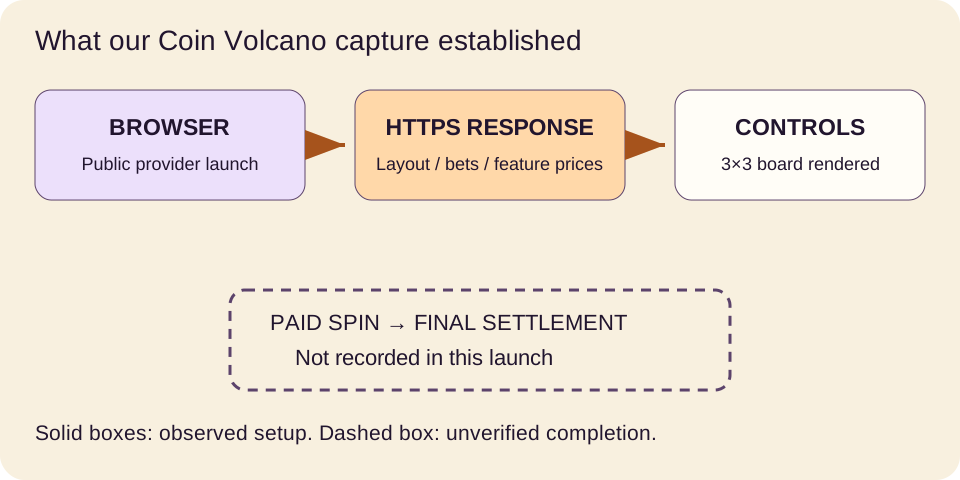
There is also a difference between studying a rule and proving an advantage. We captured the original client’s rules and initial configuration, but recorded zero completed paid rounds from its unreliable public launch. No observed RTP, hit rate or profitable backtest can be calculated from that sample. Zero is the sample size, not the game’s RTP.
This page therefore explains the supported mechanics and the tests a meaningful strategy would need. It does not present made-up win rates or a borrowed sample from another slot. The calculator can help you plan exposure, while the illustrated rules explain the feature sequence.
RTP needs a configured percentage and a denominator
Theoretical return to player describes the expected returned proportion of total stakes over the game’s mathematical distribution. Observed return describes what a measured sample actually returned. A short session can sit far above or below its theoretical value. Neither number tells you what the next spin will return.
We have not verified the selected theoretical RTP of the captured session. The client contains an RTP display placeholder, but the saved initial response did not supply a usable value for it. A percentage repeated by review pages would not establish the active configuration of the session you open. Check the game’s own information panel there.
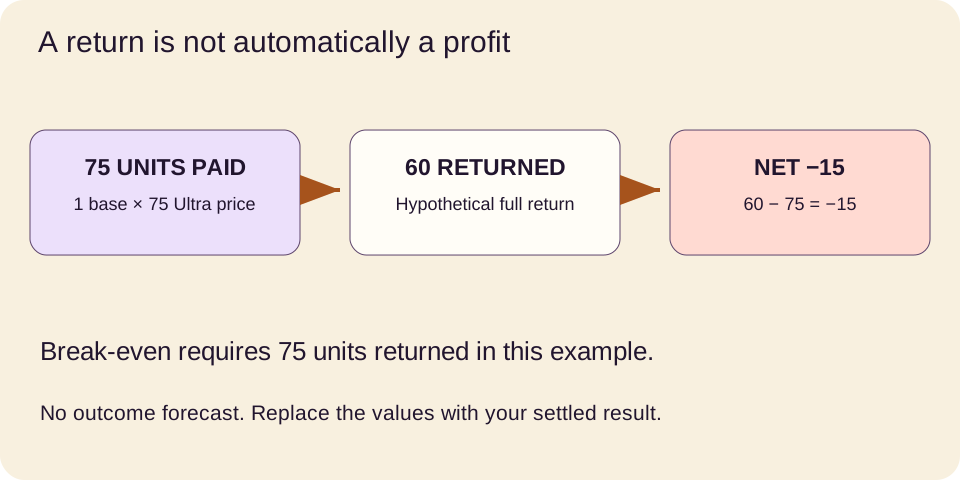
To calculate observed return, divide the sum of settled returns by the sum of the actual paid charges. Multiply by 100 to express the result as a percentage. For ordinary spins, the charge is the total bet. For a purchased feature, use 30 or 75 times that base bet in the original configuration.
For example, ten hypothetical purchases costing R30 each spend R300. If all ten completed features return R270 together, observed return is 90% and net is −R30. Dividing that R270 by ten R1 base bets would produce 2,700%, which is not the return on the R300 actually spent.
An incomplete feature has no settled final return yet. Keep it separate from settled results until completion or a documented operator settlement. Excluding losing outcomes while keeping winning ones also distorts the calculation. A chart becomes useful only when the inclusion rule and paid costs are consistent.
The same caution applies to currency. FUN is a virtual unit, not a rand balance or a conversion rate. A FUN demonstration can show how a feature works, but it cannot verify a local deposit fee, a rand stake limit or a withdrawal process.
Six betting ideas and what they actually change
Fixed stakes keep the base amount stable. This makes a session easier to compare because a return multiplier maps to the same unit each time. It also avoids clearing Sticky Coins through a bet change. Neither benefit proves positive expected value; it simply reduces accounting confusion and one avoidable rule interaction.
Increasing after losses, often called Martingale, changes exposure. It does not make a missing bonus more likely. Coin Volcano also lacks a simple guaranteed even-money win that restores a doubled sequence. A feature can return something while still failing to cover the accumulated stakes.
A capped progression stops increasing at a chosen maximum. That prevents an unlimited sequence of raises, but losing actions below the cap still cost money. Record whether a test stopped because the cap was reached. Omitting that stopped sequence would make the system look more durable than it was.
Waiting for a sticky symbol before raising the bet conflicts with the original bet-change rule: playing at another bet removes the current Sticky Coins. Even if a pattern looked appealing on a screenshot, the proposed action changes the state you were trying to exploit. That is a mechanical objection, not merely a general warning about randomness.
Buying Ultra after several unsuccessful ordinary spins changes the next charge from one base unit to 75. The preceding losses do not establish a discount or a compensating guarantee. To test the idea honestly, compare its complete cost with a predeclared alternative at the same budget.
Stopping after a profit or loss threshold changes when you stop wagering. It can be useful for sticking to a spending plan. It does not change the distribution of the next available feature. A reported profit from one threshold also needs the number of sessions and all stopped losses alongside it.
These distinctions are useful even without a statistical model. Ask which variable an action changes: the stake, the mode, the number of attempts or the game state. Then check whether the claimed benefit follows from a rule or from an untested story. A visual coincidence is not a verified mechanism.

What would count as a useful strategy test?
Choose the rule before collecting the test sample. For example, define a fixed base bet, a maximum total spend and exactly when a feature purchase is allowed. Record every paid action in order. Do not adjust the rule after seeing a bad result and still call the entire sequence an independent test.
A first exploration can suggest candidate settings. A separate later sample is needed to see whether they hold up. If you try many thresholds on the same short history, some may look profitable by chance. The number of attempted settings belongs in the interpretation, even when only the best result is displayed.
Keep complete returns rather than only pictures of large awards. Feature purchases and ordinary spins need different cost fields. Child respins belong to their parent paid action. A useful record includes action order, mode, base bet, total charge, final return, balance before and after, and whether settlement completed.
For a hypothetical balance check, start at 500 units. Two purchases cost 30 each and return 12 and 48. The final balance is 500 because 500 − 60 + 60 equals 500. One purchase lost 18 and the other gained 18. Showing only the 48-unit return would misrepresent the pair.
Report maximum drawdown as well as the final result. Drawdown describes the drop from an earlier balance peak, not just the distance from the initial balance. A strategy can end slightly positive after an uncomfortable fall. That path matters to a player with a finite budget, even when the final column is green.
Use real completed-round history to reconcile the record when the operator provides it. A screen animation can be delayed or interrupted. Request identifiers and final balance changes help connect the visible event to its actual settlement. Private session tokens should never be included in a public download.
Until a complete sample exists, a modelled exercise must be labelled as simulation. It needs a justified probability model too. We have not reconstructed the full game mathematics from a few client settings. This site therefore does not claim a faithful outcome simulator or a validated predictor for Coin Volcano.
What the browser receives before a spin
The observed public client loads a graphical game interface and sends HTTPS requests for login and initial state. The initial response supplies a 3-column, 3-row layout, a middle-row line definition, permitted bet amounts and the two feature-purchase prices. These settings are useful for identifying the original game.
The initial state listed ordinary spin and feature-purchase actions as available. We did not manually invoke those interfaces or try hidden server commands. Reading an action name in a response is not proof that an arbitrary call is supported, and it is not a way to predict a result.
The response also contained internal feature settings and arrays. Their names alone do not establish a complete probability distribution. In particular, a field containing the number 32 cannot responsibly be converted into a one-in-32 trigger claim without the relevant implementation and verified meaning. The game’s visible rules take priority for user-facing mechanics.
Our captured launch used HTTP requests rather than an observed game WebSocket stream. That describes this launch only. It does not prove the provider never uses WebSockets in another mode, account environment or build. No live-winner feed was established for this game in our capture.
The session later returned a GAME_REOPENED error and displayed a message saying the session had closed. We have not established the root cause. It is not evidence that a player won elsewhere, that a bet was settled or that a country is blocked. The demo troubleshooting section separates those possibilities.
The private capture retains the full ordinary traffic for inspection. Public explanations omit session credentials and unrelated tracking. A useful technical account explains what a field means and what it does not prove; publishing raw identifiers would add no player value.
Measured setup time is not a South African ping test
Across four initial-state requests on 4 November, our recorded request-to-full-response times were 152, 274, 377 and 393 milliseconds. The median was 325.5 milliseconds. Four login responses took between 1,185 and 2,465 milliseconds. These are small setup samples from the research desktop connection.
The measurement includes network travel, server work and local response handling. It is not one-way latency, animation speed or a physical South African mobile-network test. A fast settings response also did not prevent a later session-closed error. No paid-spin response timing was available, so we do not advertise a millisecond spin speed.
Use the information for a better decision
Check the exact game first. A 3×5 Coin Volcano 2 screenshot or a phone app with levels does not describe the original 3×3 rules. Then identify the unit shown on the balance and the full amount of the action you are considering. Those two checks help you identify the game and understand its cost before trying a timing system.
Use a spending ceiling that includes every purchase at its full price. At a hypothetical R1 base bet, four ordinary purchases cost R120 before returns. Four Ultra purchases cost R300. The word “four” hides a substantial difference until the money is stated.
If you prefer to stop at a certain loss, apply that rule before another paid start. Do not treat already spent money as a reason to raise the stake. If the next action is too large for the remaining budget, the rule should end the session rather than silently expand the budget.
There is no verified profitable setting to recommend from our zero-round sample. What is established is the cost structure, the sticky exclusions and the difference between feature return and net result. These are concrete constraints you can use immediately when reading a game screen or a claimed strategy.
For an editable example, use the purchase and return calculator. For account or app confusion, use the version and login guide. A partner link opens a separate service; it does not certify the title’s availability, licensing or the claims made in that service’s promotions.